
By Grace Kirk
When 13-year-old Alexa Brennan read the diagnosis Anorexia Nervosa across her doctor’s screen, she didn’t know what it meant.
“I just wanted to be skinny like my friends,” said Brennan, now 21-years-old and a junior cross country and track athlete at the University of Maine.
Brennan is one of nearly 46% of collegiate female endurance runners who have struggled with disordered eating, according to a study published by Dr. Paul Krebs. Krebs is affiliated with the Department of Health and Sport Science at the University of Daytona. Just under 300 female athletes participated in his study, from 25 NCAA division one cross country and track programs.
Running her first road race in 4th grade, Brennan would grow to love the sport as she entered high school. It was then that her disordered eating habits would return despite her efforts at recovery throughout middle school.
As she began to take the sport seriously, and see individual success, she became more aware of the other runners around her, often feeling like she didn’t quite belong.
“When you’re in highschool and you’re still figuring out who you are, you’re at an age where things really have an impact on you.” said Brennan in reference to watching talented, and thin, athletes succeed.
Stereotypes regarding leanness, muscle mass, and overall body image are often stressed throughout the sport, leaving harmful impressions on countless young female runners. Krebs noted that eating disorder rates were much higher in sports like endurance running, justifiable by these “sociocultural pressures.” There is often a dangerous connection that leanness will always lead to higher level performances.
Similarly to Brennan, Katie Palmateer, a freshman cross country and track athlete at the University of New Hampshire, grew aware of these stereotypes once she began to specialize in the sport in highschool. Previously, Palmateer played a variety of other sports including soccer, softball, and skiing. She recalls running was different in that she never felt the same expectation to be thin in her other sports.
“With running I always felt like I was too big or too slow, like I was never good enough,” said Palmateer.
It was the summer going into her sophomore year when Palmateer attended a sports camp that struck her. The camp sponsored a “nutrition test” that measured things like BMI and body fat percentage. Though she opted not to partake in the exercise, she began to hyperfixate on her own nutrition; wondering how much better she might be if she just lost a little weight. This mentality carried her until her 17th birthday when her doctor noted serious health issues as a result of under eating.
“I had a low heart rate, bone density concerns, and hadn’t been gaining weight and I had to stop running to restore my health,” said Palmateer.
While stories like hers are common, especially at the collegiate level, the topic still remains taboo.
Both Brennan and Palmateer agreed that they felt extremely alone throughout their journeys. Brennan said she chose not to tell anyone, even close friends and coaches.
“I felt very alone, and the issue is that it’s not talked about,” said Brennan. This silence extends to the NCAA, which has done few things in combating disordered eating within the association.
In 1999 the NCAA conducted a study measuring the prevalence of eating disorders across all sports and genders. Their results proved conservative when compared to other research, though they uncovered that female athletes were seeking a dangerously low body-fat percentage.
“A subtle, but particularly disturbing, finding among the female athletes was that, overall; their goal was to achieve a body fat content that would result in amenorrhea.” read their final report. Amenorrhea is the absence of a women’s menstrual period and can lead to infertility, osteoporosis, and increased risk of cardiovascular disease, according to the Mayo Clinic. Despite this knowledge, there is still no formal legislation from the NCAA regarding protocol or education surrounding eating disorders.
In the early 2000s when concussion research expressed concerns for the well-being of students-athletes, the NCAA implemented nationwide legislation. The legislation requires universities to have protocols in place for athletes who exhibit concussion symptoms, including mandatory time away from sport and a strict return to play program. Additionally, it requires annual education about the signs and symptoms of concussions that the student-athlete must confirm they received in order to begin competition.
Whether or not we can expect similar legislation to follow in regards to eating disorders is unclear. The NCAA did launch a study titled the Female Athlete Body(FAB) Project in 2014. FAB is an experimental eating disorder prevention program designed for women’s teams. However, information about the program has not been updated on the NCAA website since 2015 and implementation has not occurred in universities.
“We have student athlete awareness programs for other parts of mental health care, but nothing for eating disorders,” said Brennan, in support of creating new programs to benefit athletes struggling with disordered eating. She also doesn’t believe these programs should stop at the collegiate level.
According to data collected by the National Federation of State High School Associations, track and field has remained the most popular sport among high school aged female athletes for over a decade. Since 2009, over five million female athletes nationwide have participated in track and field, besting the next most popular sport by over half a million athletes.
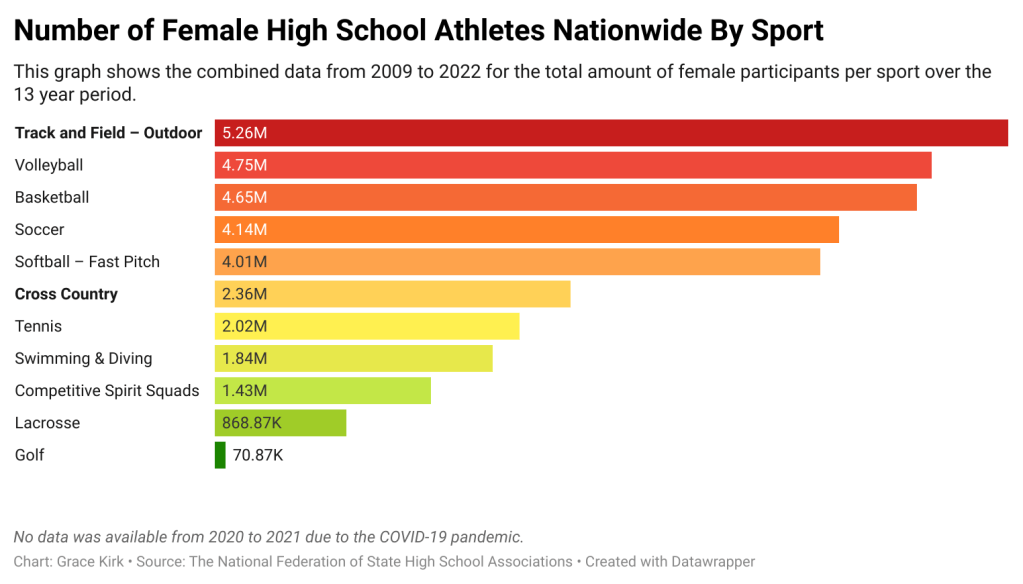
With so many young athletes partaking in the sport, Brennan believes these programs should be extended to the high school level as well. Nutrition is rarely taught in highschools, especially not specifically enough for athletes. And knowing how much to eat in order to sustain yourself, especially when exercising to a high level, doesn’t always come naturally.
“I was still eating the same but was training way more than before. I didn’t understand that it was ok to eat more than your friends, boyfriend, or family. I didn’t understand that it’s ok to eat to your body’s needs.” said Brennan when talking about her own struggles with figuring out her nutritional needs in highschool.
For coaches and trainers, it is imperative that they are not only able to recognize early signs that an athlete may be struggling but have the ability to provide effective care.
“People know about eating disorders but they don’t know what to do to help or what potential signs are,” said Palmateer. Jennifer Vaughan of the Northern Kentucky Independent District Health Department had similar discoveries.
Vaughan found that only 27% of collegiate athletic trainers were confident in their ability to diagnose an athlete with an eating disorder, from her survey of 171 trainers from NCAA division 1 schools. She also found that nearly half of athletic trainers surveyed believed they could not provide adequate support for a student with an eating disorder.
93% of athletic trainers agreed there should be increased attention at preventing eating disorders in all female athletes, endurance runners being just one example of the larger issue. To be a young woman growing up in sports is to become critical of your figure before understanding your health. Education and prevention could prove essential in protecting children and teens finding themselves in the world of sport.
 Grace Kirk Media
Leave a comment