
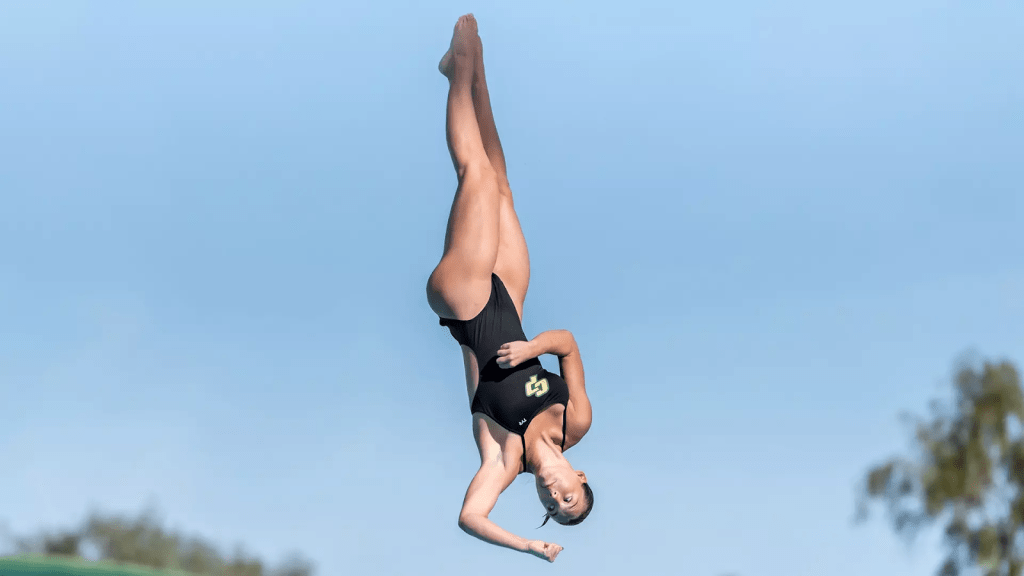
A diver at California Polytechnic State University(Cal Poly) competes in the team’s final regular season meet in January. Photo by Jawei Kuo
Grace Reed parked her car outside Stokes athletic center, just as she had nearly every day since she began playing field hockey at Saint Francis University(SFU) in Loretto, Pennsylvania.
Out of habit, she grabbed her cell phone and read the notifications that had popped up during her drive.
One was an email from her university.
As of March 25, Reed was no longer a Division I athlete, the email read.
“Being a DI athlete was my dream,” Reed said. “For it to be taken from me in an email, I was devastated.”
Reed is one of nearly 650 SFU student-athletes receiving this news. Countless others await their fate as NCAA teams across the country face a consequential decision on a multi-billion dollar settlement, set to reinvent college sports, that inches closer to approval.
The House v. NCAA antitrust lawsuit addresses several key issues regarding student-athlete compensation in collegiate sports. The settlement won’t impact every student-athlete equally. Scholarships have already been revoked and non-revenue programs, as well as non-scholarship, “walk-on,” athletes, are facing cuts.
Judge Claudia Wilken approved the preliminary settlement in October. Her final decision is expected in the coming weeks.
The landmark settlement will introduce a revenue sharing model. Athletic departments that choose to opt in will be able to share up to 22% of revenue with their athletes. By opting in, they also allow the NCAA to impose roster limits in every sport. Previously, there were no caps on roster size, though schools were limited in the amount of full scholarships they could provide.
The settlement will largely benefit student athletes in high-revenue sports, such as basketball and football, and conferences, particularly the Power Five which includes the Big Ten, Southeastern Conference, Atlantic Coast Conference, Pac-12 Conference, and Big 12, leaving those at smaller universities and non-revenue sports to take the hit.
Each DI university must also pay a part of $2.78 billion in back pay damages to current and former athletes, competing between 2016-2024, who were restricted from earning revenue from their name, image, and likeness. Opting out of other provisions within the settlement does not make a university exempt.
Partly due to the financial impact of the settlement, SFU announced that the university will be reclassified as a DIII institution beginning in the next academic year, joining the Presidents’ Athletic Conference.
“The world of DI has changed around us, and we’re making this change for the good of student-athlete welfare,” said university president Father Malachi Van Tassell at a press conference. DIII universities have smaller budgets, less facilities, and a larger emphasis on academics than their DI counterparts. Most notably, DIII universities cannot offer athletic scholarships.
As a smaller institution, SFU does not have the ability to compete with other D1 schools that could promise large paychecks to incoming recruits and transfer athletes, Rev. Tassel added.
Reed started playing field hockey at age 9. By the time she reached high school, Reed played club year round in addition to being a standout forward on her high school team, breaking the school’s record for most goals.
Reed then had to decide if she should give up on her dream or enter the transfer portal, a risky move that could not only delay her graduation, but increase financial obligations to her family. If she stays at SFU, Reed’s scholarship, along with those of her fellow student-athletes, will carry over only for the next two years- long enough for her to finish her degree.
“I’m glad I’m a sophomore so I at least have the choice to stay,” Reed said. “A lot of our freshmen are entering the portal, and I don’t blame them.”
As the financial burden to universities sinks in, program cuts may be the only thing keeping them afloat. For some athletes the choice isn’t to play at a lower division or transfer, it’s to stop competing entirely, or enter the portal.
The first DI programs cut as a result of the settlement were the California Polytechnic State University (Cal Poly) men’s and women’s swimming and diving programs in March, which affected 58 student-athletes.
“I believe this is the hardest thing you could ask any collegiate athlete to go through,” said junior Cal Poly swim captain Jen Reiter in an online statement.
Cal Poly announced the cuts in a letter also addressing several administrative and organizational changes within the university, though president Jeffrey Armstrong noted the impact of the settlement as a key motivator.
“Unfortunately, Cal Poly is not immune to the rapidly evolving and changing NCAA Division I landscape, which presents many challenges and uncertainties for collegiate athletic programs,” Armstrong said. “The House vs. NCAA settlement, which addresses past and future compensation for student athletes related to name, image and likeness (NIL) rights, will have a significant financial impact – resulting in a loss of at least $450,000 per year for our programs.”
The University of Texas at El Paso also cut its women’s tennis program in April for the same reason. According to Noah Henderson, clinical instructor of sport management and director of the sport management program at Loyola University Chicago, more program cuts are to be expected in the coming months.
“What we are seeing now is still preemptive as the settlement hasn’t even been approved yet,” Henderson said. If programs are already being cut, there is no telling what could happen after final approval.
The roster limits imposed on teams at universities choosing to opt-in to all the provisions will also lead to mass cuts of walk-on athletes.
Team rosters typically exceed current scholarship limits. The new roster caps will fall somewhere in between the current scholarship restrictions and the average roster size, which varies by sport, leaving walk-on athletes vulnerable.
Oregon State University (OSU,) which competes in the Pac-12 Conference for football and West Coast Conference for all other sports, has already started resizing its rosters.
Among those cut is OSU walk-on track athlete Vera-Lyse Rose.
“I put so much time, energy, and heart into sport and into representing OSU,” Rose said. “It wasn’t just about losing a spot on the team, it felt like I was losing a part of my identity.”
Rose, a sophomore studying business management, came all the way from France to compete at OSU, an expense her parents proudly took on if it meant she could pursue her dreams both on and off the track.
While lower revenue sports like track typically have a higher percentage of walk-on athletes, nearly 50% of all DI athletes are not on scholarship.
“It depends on the sport,” Henderson said. “But no matter how you look at it, there’s a lot of athletes who will be getting cut this year.”
For now, Reed has decided that she will continue playing the game she loves at SFU, putting her academic needs first. She plans to graduate in 2028 with her undergraduate degree in health science and masters in occupational therapy.
As for her team, Reed said they’re remaining positive and taking it all day by day.
“Right now we’re doing all we can to focus on what’s in front of us and be where our feet are,” Reed said. “We’ve got a scrimmage coming up and that’s what we’re worried about.”
 Grace Kirk Media
Leave a comment