
By Grace Kirk
Survivors of Maine’s deadliest mass shooting say a recently filed lawsuit will expose unresolved military reporting failures similar to those found in a case out of Sutherland Springs, Texas, raising the question of whether systemic Army lapses enabled a preventable tragedy.
The survivors are seeking accountability from the Army, Department of Defense, and Keller Community Hospital.
“We trusted those in power to protect our loved ones and their inaction cost us everything,” Cynthia Young, a plaintiff whose husband and 14-year-old son were killed in the shooting, said at a press conference. “No family should have to endure this heartbreak when so many warning signs were ignored.”
Long before Army reservist Robert Card murdered 18 civilians and wounded another 13, on Oct. 28, 2023 in Lewiston, the US Army had knowledge of his deteriorating mental health and failed to follow its own policies that could have prevented the tragedy, the lawsuit alleges.
The lawsuit, Seal v. United States, which refers to the shooting as “one of the most preventable mass tragedies in American history,” was filed in the U.S. District Court for the District of Maine and lists over 100 plaintiffs.
The plaintiffs are represented by four law firms, including Koskoff, Koskoff and Bieder of Connecticut, which successfully represented the plaintiffs in the Sandy Hook Shooting lawsuit against Remington, and National Trial Law of Texas, which represented the plaintiffs in the Sutherland Springs lawsuit.
The lawsuit repeatedly refers to internal investigations by the Department of Defense Office of Inspector General and Department of the Army, into the events that led to the shooting. The investigating officers in both reports have been redacted.
A third investigation by an independent commission, established through executive order by Governor Janet Mills, is also cited. The independent commission was comprised of retired justices of the Maine Supreme Court, Daniel Wathen and Ellen Gorman; forensic psychologist Debra Baeder; attorneys George Dilworth and Paula Silsby; and psychiatrist Anthony Ng.
Before the Shots Were Fired
As early as July 2022, over a year before the shooting, Card’s unit commander, Captain Jeremy Reamer, knew he was experiencing paranoia, hearing voices and accusing others of calling him a pedophile and gay, the lawsuit alleges.
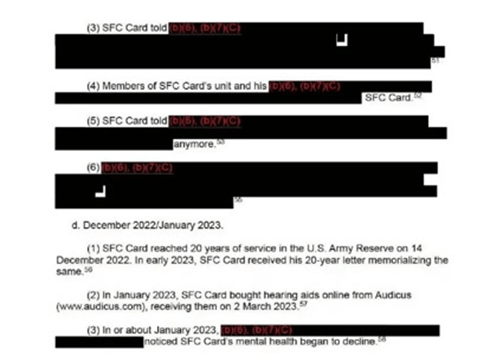
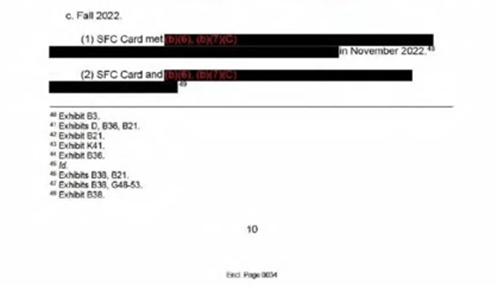
Heavy redactions under section 3.B.17.C “Fall 2022” of the Army’s investigation, make it impossible to confirm if Card’s command was aware of his deteriorating mental health in 2022.
An unredacted section of the Army’s investigation claims that, “There are no reports of SFC Card hearing voices prior to 2023,” though it confirmed that Card did accuse his colleagues of such harassment in early months of that year.
Page 10, section 3.B.17.C, from the U.S. Army Investigation into the Suspected Suicide of SFC Robert Card II.
Page 11, section 3.B.17.C, from the U.S. Army Investigation into the Suspected Suicide of SFC Robert Card II.
Even if Reamer was not aware of Card’s mental decline, he would have had to investigate accusations of harassment under the Army’s Harassment Prevention and Response policies. If Reamer had done so, he would have learned that the accusations were unsubstantiated and that Card was showing signs of mental deterioration, the lawsuit claimed.
In April, someone from Card’s unit instructed another service member, “to keep up with SFC Card and to investigate the matter further,” the Army investigation said. Names of these service members were redacted and no further documentation of an investigation into the harassment was provided.
A month later, Card’s son Colby told his mother Cara Lamb, Card’s ex-wife, that he no longer felt comfortable staying at his father’s home due to his mental decline and access to firearms, all investigations reported. The two brought these concerns to the resource officer at Mt. Ararat High School, Gabrielle Mathieu, who reported it to the Sagadahoc County Sheriff’s Office, according to a police report. The responding officer from the Sheriff’s office, Chad Carleton, spoke with Colby and Lamb the same morning in Mathieu’s office, the report notes.
The Sheriff’s office then contacted Card’s unit and spoke with First Sergeant Kevin Mote, who told them they were aware of Card’s condition and had a plan to get him help, including a meeting at the upcoming battle assembly, according to Mill’s independent commission. None of the investigations show evidence that Card’s command attempted to meet with him at battery assemblies, mandatory Army reserve training weekends that occur once each month, in May or June.
Card’s family became increasingly concerned about his mental health over the summer.
In June, Card’s sister Nicole Herling, contacted the VA crisis line and was advised by the worker not to inform Card’s command about his delusions as it could harm his career, Herling told the independent commission under sworn testimony. Herling made several attempts to contact Card’s unit throughout the month, leaving five voicemails that were never returned.
On July 16, Card was in New York for a training weekend at West Point when he began accusing his fellow soldiers of talking about him behind his back. Despite their reassurances, Card became aggressive and New York State Police were called to the scene.
Publicly released body camera footage from the responding officers shows Card saying that his fellow reserve Soldiers are, “scared because I am capable.”


Body camera footage of Robert Card from the New York State police on 16, July, 2023.
Following this threat, Card’s commanding officers, including Mote and Reamer, ordered a Command-Directed Evaluation of Card’s mental health, all investigations stated.
A commanding officer cannot order a Soldier to complete a psychiatric evaluation against their will unless the Soldier presents a serious risk of harm to themselves or others, through actions or threats, and that, “intent to cause such injury is likely,” according to Army Medical Command policy and Department of Defense instruction.
Card was evaluated at Keller Army Community Hospital (Keller), where medical professionals recommended Card be transferred to a psychiatric facility, all investigations reported. Card was then admitted to Four Winds Hospital in New York.
Following his transfer to Four Winds, Card’s command received a DA Form 3822 “Report of Mental Status Evaluation” from Keller, completed by Captain Matthew Dickison.
The form said that Card did not meet medical retention standards due to the psychosis he was experiencing and directed his command to perform a Disability Evaluation System Referral which would “facilitate his discharge from the military,” the Army investigation states. Card’s command failed to do so, all investigations affirm.
The form also required Card’s command to remove all firearms and weapons from Card’s home and ensure that he attends all follow-up appointments. Again, all investigations found that Card’s command failed to do so.
“I was all about making sure the service member did not have access to weapons,” Dickison testified to the independent commission. Reamer appeared to understand all the recommendations listed on the form when Dickison gave it to him and did not express any concern about enforcing them, Dickison said.
Card was released from Four Winds on Aug. 3, under “questionable circumstances,” according to the Army’s investigation. Army policies state that Card’s command should have kept him on active-duty status following his release, until a Line of Duty Investigation and Medical Evaluation Board’s review were complete. This would make the government accountable for his continuation of care and cost of treatment.
Had Card’s command followed Army policies and moved forward with the investigation and review, Card would likely have been considered a danger to himself or others, requiring the Army to report him to the FBI’s NICS system, the lawsuit argued. This would have made it illegal for him to buy or possess a firearm under federal law.
“The DoD acknowledged systemic failures caused the Lewiston tragedy,” Benjamin Gideon, lead plaintiff attorney, said in a press release. “Despite multiple opportunities to intervene, the Army failed again and again, with devastating consequences.”
The plaintiffs argue that these failures mirror the systemic breakdowns exposed in another high-profile case.
Lessons From Sutherland Springs
For the victims in Holcombe et al. v. United States of America, the Sutherland Springs case, who received $144.5 million in an April 2023 settlement with the Justice Department, DoD’s failure to follow its own policies is all too familiar.
Before he became the Sutherland Springs gunman, Devin Kelley was an airman in the Air Force. Kelley was dismissed from the Air Force in 2012 following a domestic violence conviction that, under federal law, would have prevented him from possessing firearms, but was never reported to the FBI’s background check system.
As early as 1997, the DoD knew that all military branches had a pattern of not reporting criminal history information to the FBI, according to a report from the Defense Department’s Office of the Inspector General published that year. The Air Force had a 50% reporting compliance rate.
The report included recommendations for reporting procedures across all branches while the OIG developed a new DOD instruction to increase reporting rates.
A second IG investigation in 2015 showed an increased reporting compliance rate at a 70% average across branches. The OIG recommended that the branches take prompt action to submit the missing information to the FBI.
A follow-up evaluation in 2017 found that the reporting compliance rate remained at an average of 70% across branches. Again, the OIG recommended that the branches report the missing information to the FBI immediately.
Another follow-up evaluation in 2020, following the beginning of litigation on Kelley’s shooting, found that, with a few exceptions, the branches reported all the criminal history information as required.
OIG Reports and Unenforced Recommendations
There is no fool proof way to enforce OIG recommendations. Reform often takes years, if it’s ever accomplished, due to a lack of accountability, bureaucracy, and insufficient resources, said Sean Timmons, managing partner of the law firm Tully Rinkey and former active duty Army Captain in the Army Judge Advocate General’s Corps.
According to the DOD OIG semi-annual report, as of March, there were 1,505 open recommendations, nearly a third of which were over four years old.
Politics and cultural norms within the DoD also play a role. Often generals are fired if they point out too many flaws within the system, Timmons said.
“The IG program in the military is a joke.” Timmons said. “I’ve represented over a dozen inspectors general who had a career cut short because they were actually trying to hold a command accountable to the regulations.”
In addition to the gross negligence of his command, the OIG investigation of Card’s shooting found that there was a trend of underreporting violent threats by service members across all branches. “Failure to consistently report violent threats to MCIOs could increase the risk of additional violent incidents by Service members,” the investigation said.
The OIG included recommendations in the report for each branch to implement, including the creation of policies that explicitly address threats to civilians and non-government facilities.
The full list of requirements for a violent threat to be reported was redacted from the OIG investigation, though the report did state that only about 50% of those required were actually reported to their respective military criminal investigative organization.
The Legal Fight for Accountability
For the government to be held legally liable under the Federal Tort Claims Act (FTCA), the plaintiffs must prove that the government was negligent under the substantive law from the state where the incident occurred. The FTCA is the legal framework that waives government immunity, allowing it to be sued.
The FTCA determines if the claim can proceed, while Maine negligence law will determine if the government is actually liable in this case.
The plaintiffs will need to show that the government owed them a duty of care, that it failed to meet that duty, that this failure caused their injuries, and that they suffered actual harm, according to Maine law.
11 counts of negligence are presented in the lawsuit:
- Negligent Undertaking in the Investigation and Management of Robert Card’s Mental Health Crisis.
- Negligence in Responding to Danger Within the Foreseeable Zone of Risk.
- Negligence of the United States in Violating Its Own Commitments, Orders, and Conditions of Card’s Release Back into the Community
- Negligent Care, Treatment, Discharge, Follow Up, and Failure to Warn.
- Negligence and Negligent Undertaking of United States in Failing to Follow Process for Line of Duty Investigation and Medical Board Adjudication of Robert Card’s Illness.
- Negligence and Negligent Undertaking in Failure to Report Card to the FBI Background Search Database Based on His Commitment to a Mental Institution.
- Negligence in Failure to File SAFE Act Report
- Negligent Training
- Negligent Supervision
- Negligent Infliction of Emotional Distress (Bystander Claims)
- Negligent Infliction of Emotional Distress (Zone of Danger)
If any, or all, of these claims are successful, accountability is likely to take monetary form, as the FTCA only governs financial liability and does not require admissions of wrongdoing.
Should the case reach a settlement instead of going to trial, it is unlikely that a public admission of guilt would come from the settlement, said Karl Protil, an expert on FTCA law and attorney from the law firm Shulman Rogers in Virginia.
“There might be a meeting [during settlement discussions] where there’s a chance to be heard and get an apology, but that’s typically all you’ll get,” Protil said. “And that’s not an acknowledgment of responsibility.”
Federal Rules of Evidence (Rule 408) protects the confidentiality of settlement discussion, meaning that if an apology or admission did occur it would not be available publicly.
Due to the recent government shutdown, a motion to stay was granted to the US, pausing the litigation temporarily.
Advancements in the case are expected in the coming weeks.
 Grace Kirk Media
Leave a comment